
Discovering Sake: An Essential Guide to Japan’s Iconic Rice Brew
Embark on a fascinating journey into the world of sake, Japan’s revered national beverage. Often misunderstood and mistakenly labeled as “rice wine,” sake offers a captivating spectrum of flavors, aromas, and cultural significance. This comprehensive guide will demystify sake, providing you with everything you need to know, from its ancient origins and intricate brewing process to proper serving etiquette and delicious recipes. Prepare to elevate your appreciation for this elegant and versatile drink.
Sake has captivated palates worldwide, not just for its unique taste but also for its fascinating cultural heritage. While we cherish those delicate sips in our favorite Japanese eateries, there’s a growing desire to explore and enjoy sake’s complexities from the comfort of home. For many, it’s a delightful alternative to the usual evening glass of wine. It’s truly an acquired taste, and personal preferences vary widely; some aficionados, like ourselves, often gravitate towards the rich, unfiltered varieties served chilled, appreciating their robust character over the smoother, often warmed, filtered options.
Beyond its sensory appeal, sake is increasingly recognized for potential health benefits. From properties linked to anti-aging to aiding in allergy reduction, exploring sake can be a rewarding experience for both your palate and your well-being. This guide aims to enrich your understanding, encourage you to experiment with different types, and discover why this ancient Japanese spirit deserves a place at your table.
Originating from the island nation of Japan, sake has journeyed across continents, embedding itself in diverse culinary landscapes. Its global rise naturally sparks curiosity: Where did this distinctive beverage begin, and what is the best way to savor its unique essence? We’ve crafted this comprehensive guide to answer all your burning questions, providing a deeper understanding of sake’s rich origins, production, and the nuanced art of enjoying it.
What Exactly is Sake? Understanding Japan’s National Beverage
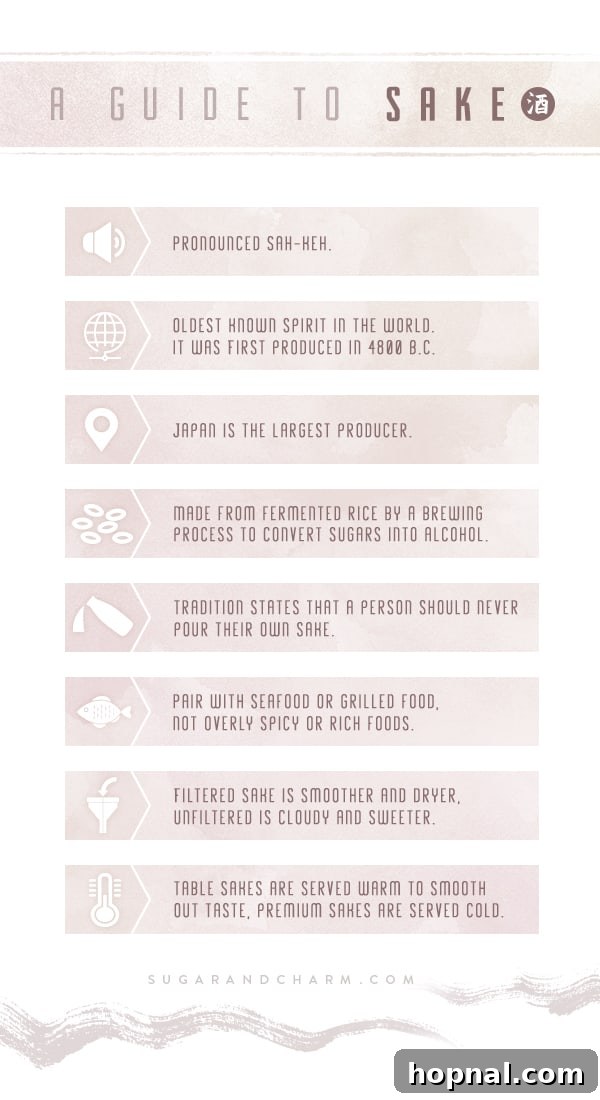
Sake, often dubbed the “national beverage of Japan,” is fundamentally a fermented rice beverage. While it’s commonly referred to as a “rice wine,” this classification is somewhat misleading. Unlike wine, which is made from fermenting fruit (grapes), sake’s brewing process is more akin to that of beer, involving a unique multi-step fermentation of polished rice. This complex method uses water, yeast, and a special mold called *koji-kin* to convert rice starches into sugars, which are then fermented into alcohol.
The quality of sake is often perceptible even before the first sip. Premium sake is typically served chilled, allowing its intricate flavors and delicate aromas to fully express themselves. While it can certainly be enjoyed warm or at room temperature, many enthusiasts and brewers advocate for chilled serving to appreciate the full spectrum of nuanced flavors infused into this exquisite beverage.
Key Ingredients and Their Role
The magic of sake comes from a synergy of four core ingredients:
- Sakamai (Sake Rice): Not just any rice will do. Special sake-specific rice grains, larger and stronger than table rice, are used. These grains are polished to remove the outer layers, rich in proteins and fats, which can impart undesirable flavors. The polishing ratio (seimai-buai) is crucial, defining the sake’s grade and character.
- Water: Water is perhaps the most critical ingredient, making up about 80% of sake. Its mineral content significantly influences the final taste and fermentation process. Japan’s pristine natural waters are a key factor in the quality of its sake.
- Koji-kin (Koji Mold): This revolutionary mold, Aspergillus oryzae, is what distinguishes sake from other alcoholic beverages. Koji is cultivated on steamed rice, producing enzymes that convert the rice starch into fermentable sugars. This is a crucial step that happens *parallel* to the yeast fermentation, a process known as “multiple parallel fermentation.”
- Yeast: Yeast consumes the sugars produced by koji, converting them into alcohol and carbon dioxide. Different yeast strains contribute distinct aroma and flavor profiles, ranging from fruity and floral notes to more savory and earthy undertones.
A Journey Through Time: The Rich History of Sake
The exact genesis of sake remains shrouded in the mists of antiquity, yet historical records suggest its presence in Japan as early as 500 B.C. The earliest known methods of sake production were remarkably primitive, involving a process called *kuchikami no sake* – literally “mouth-chewed sake.” In this ancient technique, grains of rice (and sometimes chestnuts or millet) were chewed by villagers, and the enzymes in their saliva would break down starches into sugars. This mixture was then spit into large vessels, allowing natural yeasts to ferment it over time. While perhaps unappetizing by modern standards, this method marked the very first steps in sake’s long and evolving history.
Over centuries, brewing techniques advanced significantly. The introduction of *koji* mold around the 3rd century A.D. revolutionized sake production, eliminating the need for the chewing process. This new method allowed for more controlled and efficient saccharification (starch-to-sugar conversion), paving the way for the sophisticated brewing processes Japan is renowned for today. Sake became deeply intertwined with religious rituals, court life, and eventually, the daily existence of common people. It evolved from a sacred offering to a celebrated beverage, with various regions developing their unique styles and traditions. This continuous innovation and respect for tradition have shaped sake into the complex and cherished drink it is today.
Decoding Sake: Classifications and Types
Navigating the world of sake can seem daunting due to its intricate classification system. Understanding these categories is key to appreciating the diversity and quality of this nuanced beverage.
Premium Sake Grades (Tokutei Meishoshu)
These specific designation sakes represent the highest quality, categorized by their rice polishing ratio and the optional addition of brewer’s alcohol:
- Junmai: This term means “pure rice” and signifies sake made solely from rice, water, koji, and yeast, with no added brewer’s alcohol. Junmai sakes tend to have a richer, more robust flavor profile with a higher acidity and prominent umami notes.
- Honjozo: Honjozo sake also uses rice, water, koji, and yeast, but a small amount of distilled brewer’s alcohol is added. This addition is not meant to strengthen the sake but to lighten its body, make it smoother, and enhance certain aromas. Honjozo is generally lighter and drier than Junmai.
- Ginjo & Daiginjo: These terms refer to the degree of rice polishing. Ginjo sakes use rice polished to at least 60% of its original size (meaning 40% of the outer layer is removed), while Daiginjo sakes are even more highly polished, to at least 50% (50% removed). This extensive polishing removes impurities, resulting in incredibly aromatic, complex, and refined sakes, often characterized by fruity and floral notes.
- Junmai Ginjo & Junmai Daiginjo: These combine the “pure rice” designation with the high polishing ratios, creating exceptionally clean, fragrant, and sophisticated sakes without added alcohol.
Other Notable Sake Styles
- Nigori: Meaning “cloudy,” Nigori sake is coarsely filtered, leaving fine rice particles suspended in the liquid. This gives it a milky appearance and a thicker, often sweeter, and fruitier taste. It’s distinctively rich and pairs well with bolder flavors.
- Futsushu: Often referred to as “table sake,” Futsushu makes up the majority of sake consumed in Japan. It doesn’t fall under the premium designation categories and can have a wider range of flavors and quality, sometimes with more added brewer’s alcohol.
- Koshu: This refers to aged sake. Unlike most sakes which are meant to be consumed fresh, Koshu is deliberately aged for several years, developing deeper, more complex flavors, often with honey, nutty, or sherry-like notes and a darker color.
- Sparkling Sake: A modern and increasingly popular style, sparkling sake undergoes a secondary fermentation in the bottle, similar to Champagne, resulting in a lively effervescence. It’s typically light, refreshing, and often sweet.
The Art of Enjoying Sake: Serving and Drinking Etiquette
To fully appreciate sake, understanding its serving temperatures and traditional etiquette enhances the experience significantly. This is not merely about tradition but about unlocking the full sensory potential of each brew.
Temperature Matters: Hot, Cold, and Everything In Between
Unlike wine, sake is remarkably versatile in its serving temperature, with each range bringing out different characteristics:
- Reishu (Chilled): Served at 5-10°C (41-50°F). Premium sakes like Ginjo and Daiginjo truly shine when chilled, allowing their delicate fruity and floral aromas to emerge without being masked.
- Hiya (Room Temperature): Served at 15-20°C (59-68°F). Often preferred for Junmai sakes, this temperature allows for a balanced expression of both aroma and taste, revealing more complex umami notes.
- Nurukan (Warm): Served at 35-40°C (95-104°F). Warming sake can soften its texture, reduce acidity, and bring out savory or earthy notes, making it comforting, especially in colder weather.
- Atsukan (Hot): Served at 45-55°C (113-131°F). While higher quality sakes are rarely served this hot, more robust or less refined sakes can be enjoyed atsukan, as heat can mask rough edges and enhance sweetness.
Experimentation is key, but as a general rule, highly aromatic and delicate sakes are best chilled, while richer, more full-bodied sakes can be enjoyed warm.
Traditional Serving Vessels
Sake is traditionally served in specific vessels, each with its own charm and purpose:
- Tokkuri: A ceramic or glass flask used to hold and pour sake, especially when serving it warm.
- Ochoko & Guinomi: Small ceramic or glass cups used for drinking. Ochoko are typically smaller, while guinomi are slightly larger and often more artistic, allowing for a better appreciation of the sake’s aroma.
- Masu: A square wooden box, traditionally used for measuring rice, but also for drinking sake, particularly at festive occasions. A small glass may be placed inside the masu, and sake poured until it overflows into the box, symbolizing abundance.
The Etiquette of O-shaku (Pouring)
In Japanese culture, the act of pouring sake carries significant social meaning and demonstrates respect. It is customary to pour sake for others around you before serving yourself. When someone pours for you, it’s polite to hold your cup with both hands as a gesture of gratitude. This communal act of pouring and receiving strengthens bonds and enhances the shared dining experience. A hearty “Kanpai!” (Cheers!) seals the moment, inviting everyone to enjoy the beverage together.
What Does Sake Taste Like? A Symphony of Flavors and Aromas
The flavor profile of sake is incredibly diverse and nuanced, often surprising those who expect a simple, one-dimensional drink. It truly is a beverage capable of a “symphony of flavors and aromas,” heavily influenced by a variety of factors:
- Temperature: As discussed, serving temperature dramatically alters perception. Chilled sake often highlights fruitiness, while warmed sake can bring out savory notes.
- Ingredients Used: The type of sake rice, the specific koji mold strain, and especially the yeast strain all contribute distinct characteristics. Yeast, for instance, can impart notes of apple, pear, melon, banana, or even more savory, earthy tones.
- Brewing Method: Variations in fermentation, pressing, and aging techniques create unique profiles.
Sake can range from delicately sweet to remarkably dry. While many sakes lean towards the sweeter side, particularly Nigori or certain Ginjo styles with pronounced fruitiness, others can be intensely dry, with a crisp, clean finish. Descriptors often include:
- Fruity: Apple, pear, melon, banana, lychee, citrus.
- Floral: White flowers, lily, rose.
- Earthy/Umami: Mushroom, soy sauce, rice, savory broth, mineral.
- Nutty: Almond, cashew, hazelnut.
- Spicy: White pepper, anise (subtle, not capsaicin spice).
- Grainy: Freshly steamed rice, bread.
Understanding these potential flavor profiles is essential when selecting a sake, allowing you to choose one that perfectly complements your palate or a specific meal.
How Strong is Sake? Understanding Its Alcohol Content
Sake typically has an alcohol by volume (ABV) ranging from 15% to 20%, making it considerably stronger than most beers (which average 4-6% ABV) and often slightly stronger than many wines (which typically range from 10-15% ABV). This higher alcohol content contributes to its distinct character and body.
Despite its strength, sake is traditionally consumed differently than spirits like vodka or whiskey. It’s usually sipped slowly from smaller cups, often alongside food, rather than gulped. However, like any alcoholic beverage, consuming enough sake will lead to heavy intoxication. It’s crucial to enjoy sake responsibly and in moderation, especially given its relatively high alcohol content. Awareness of its strength allows for a more controlled and enjoyable drinking experience.
Is Sake Healthy to Drink? Exploring Its Potential Benefits
The topic of alcohol and health is always nuanced, but research has suggested that moderate consumption of sake may offer several intriguing health benefits. Due to its unique brewing process and nutrient-rich ingredients, sake contains various beneficial compounds.
Some researchers have found that sake contains a high concentration of amino acids, peptides, and other beneficial compounds that may contribute to improved physical conditions. These include:
- Skin Benefits: Ingredients used in sake brewing, particularly *koji*, contain compounds like kojic acid, which is renowned in skincare for its brightening and anti-aging properties. Some studies suggest that the amino acids in sake can help moisturize the skin and improve its elasticity.
- Immune System Support: Certain components in sake, such as various peptides, have been linked to enhancing the immune system’s strength.
- Anti-aging Properties: The presence of antioxidants in sake, along with beneficial amino acids, may play a role in combating cellular damage and supporting anti-aging processes.
- Reduced Risk of Certain Health Conditions: Preliminary studies have explored links between moderate sake consumption and a potentially reduced risk of conditions like diabetes, high blood pressure, and osteoporosis, although more extensive research is always needed to confirm these findings.
It’s important to emphasize that these potential benefits are associated with *moderate* consumption. As an alcoholic beverage, excessive intake carries significant health risks. Always consult a healthcare professional for personalized health advice. However, when enjoyed responsibly, sake can be a delightful addition to a balanced lifestyle, offering more than just enjoyment.
Perfect Pairings: Enjoying Sake with Food
One of sake’s greatest strengths is its incredible versatility as a food-pairing partner. Often associated only with sushi, sake actually complements a vast array of cuisines, from traditional Japanese dishes to international fare. Its unique umami qualities and varying flavor profiles allow it to enhance and balance food in ways that wine sometimes cannot.
- Light & Crisp Sakes (e.g., Ginjo, Daiginjo): These delicate and aromatic sakes, with notes of apple, pear, or melon, are perfect with lighter dishes. Think sashimi, delicate white fish, fresh salads, oysters, or light appetizers. Their clean finish won’t overpower subtle flavors.
- Medium-Bodied Sakes (e.g., Junmai, Honjozo): With a balanced acidity and more prominent rice or savory notes, these sakes pair beautifully with grilled fish, tempura, yakitori, light chicken dishes, or even pasta with cream sauces. They have enough body to stand up to richer flavors without dominating.
- Rich & Robust Sakes (e.g., full-bodied Junmai, Koshu): These sakes offer more pronounced umami, earthy, or nutty characteristics. They can be excellent companions for heavier dishes like braised meats, stews, hearty mushroom dishes, or even strong cheeses. Koshu (aged sake) with its sherry-like notes can even pair with foie gras or chocolate.
- Nigori Sake: Its creamy texture and often sweeter profile make Nigori an intriguing pairing for spicy foods, cutting through the heat, or as a dessert complement, especially with fruit-based desserts or sorbets.
- Warm Sake: When sake is warmed, it often softens its profile and enhances savory notes, making it an excellent match for comforting, hearty dishes in cooler weather, such as hot pots, stews, or grilled meats.
The key to sake pairing is to consider the body, acidity, sweetness, and aroma of the sake in relation to the intensity and flavors of the food. Don’t be afraid to experiment; you might discover unexpected and delightful combinations!
Beyond the Glass: Creative Sake Recipes
Sake isn’t just for sipping; its unique flavor profile makes it a fantastic ingredient in both culinary creations and innovative cocktails. Its delicate sweetness and umami depth can elevate a dish or add a refreshing twist to a drink. Here are a few creative ways to incorporate sake:
Sparkling Sake Sangria with Pineapple: A vibrant and effervescent drink that combines the lightness of sparkling sake with tropical fruit, perfect for entertaining.
Honeydew Sake Sorbet: This dessert is incredibly refreshing and surprisingly easy to make, offering a sophisticated, subtly alcoholic treat that’s perfect for warm weather or as a palate cleanser.
Make-Ahead Soju and Sake Fruit Cocktails: Ideal for parties, these cocktails allow you to prepare in advance, blending the gentle strengths of sake and soju with fresh fruits for an effortlessly chic beverage.
Pronouncing Sake Like a Pro
To truly embrace the world of sake, mastering its pronunciation is a small but significant step. The correct pronunciation is “SAH-keh” (like “sock-eh”), with equal emphasis on both syllables. Avoid pronouncing it as “sah-KAY,” which is a common misconception outside of Japan.
Embracing the World of Sake
We’ve journeyed through centuries of history, explored the intricate brewing process, decoded complex classifications, and uncovered the art of enjoying sake. From its ancient origins as a sacred offering to its modern-day status as a globally celebrated beverage, sake is far more than just “rice wine.” It is a versatile, flavorful, and culturally rich drink that offers an unparalleled sensory experience.
Whether you prefer it chilled or warm, unfiltered or exquisitely clear, there’s a sake out there waiting to enchant your palate. We encourage you to continue your exploration, perhaps trying a type you’ve never encountered before, experimenting with new food pairings, or even incorporating it into your next culinary adventure. Embrace the depth and diversity of sake, and let its unique charm enrich your appreciation for Japanese culture and fine beverages.
You can also FOLLOW US onFACEBOOK, INSTAGRAM, and PINTERESTto see more delicious recipes, cocktails, desserts, and parties!